Ecological responsibility

We want to offer households and communities in the Tampere region a local, effortless, reliable and ecological way to reuse, recycle and shop affordably.

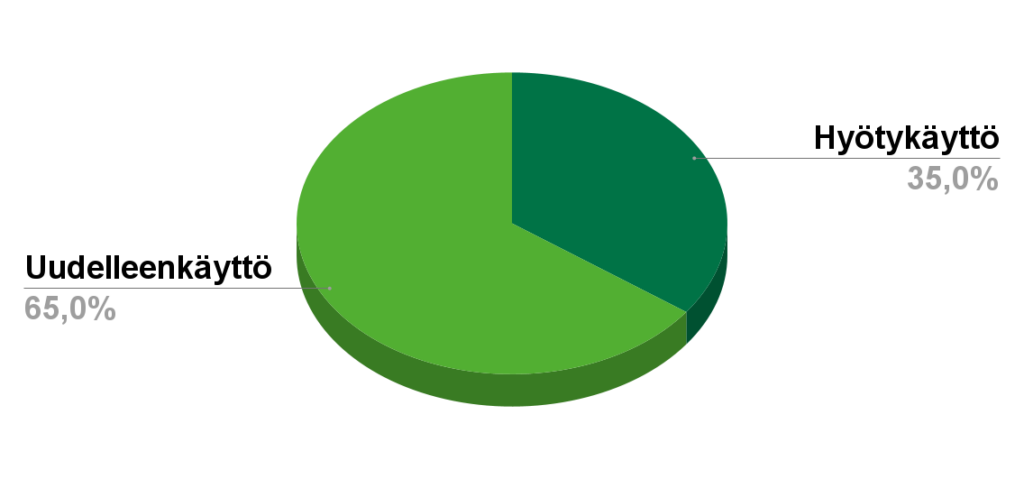
Distribution of material flows in 2022

In 2022, about 512,000 items and garments found a new home through us and were put to reuse. This figure includes all sold products, that is, furniture, electrical and electronic devices, dishes and other household items, as well as clothing and textiles. In circular economy operations, the most environmentally friendly way is to use a product again in its original purpose, that is, for instance, a chair is used as a chair.

All material is utilized

Of all material, 65 % is reused, which is about 650,000 kg per year

20 % of the material goes to recycling, which is about 200,000 kg

15% goes to heat and energy, that is, 150,000 kg 

Together with our partners, we continuously strive to develop new ways to utilize reused materials and to create business that advances the circular economy

The environmental impact of clothing and textiles in 2022

In 2022, about 30,000 kg, that is, an estimated 100,000 garments or textiles, found a new home through our second-hand stores.

The total CO2e savings for textiles in 2022 amounted to 1,029,600 kilograms of CO2e, which corresponds to the combined carbon footprint of about 100 average Finns (10,300 kg CO2e/person).

For clothing and textiles, we cooperate with Nextiili. Nextiili sorts all the textiles that come to us.

Textile material flows

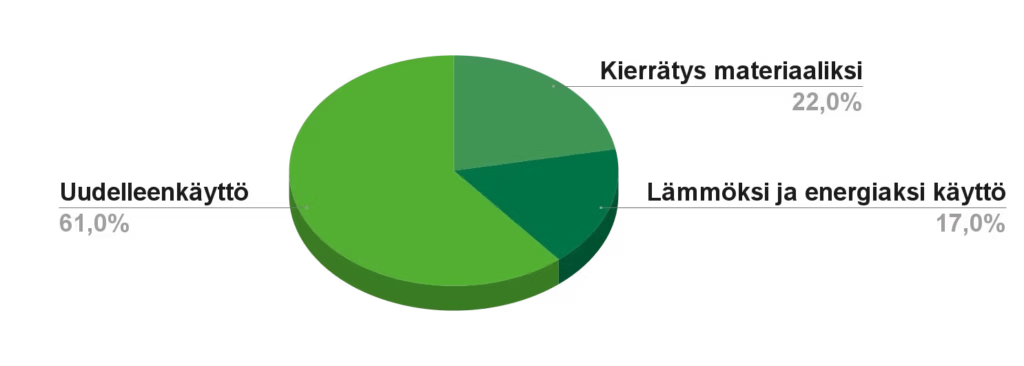
For clothing, the distribution of material flows was very similar to that of all products:

Of all textiles, 61 % is reused, which is about 40,000 kg per year

22 % of the textiles goes to recycling, which is about 14,000 kg

17% goes to heat and energy, that is, 11,000 kg 

Information about the recycling center's ecological approach

In 2022, about 17,000 pieces, that is, about 380,000 kilograms of furniture and fittings, were directed to reuse through our recycling centers.

The total CO2e savings for furniture in 2022 were about 760,000 kilograms of CO2e. The natural resource savings of the fittings have been calculated weighted by consumption, 2 kg CO2e.

Buying clothing reused is an eco-friendly act, since reuse reduces emissions by 25 kg CO2e per kilogram of clothing. Reusing other goods, such as furniture, is also worthwhile. If, for example, a t-shirt is made entirely from recycled materials, its natural resource savings are 50 % greater compared to one made from new materials. Reusing an existing product, however, saves another half as much in natural resources and is therefore the very best way to reduce emissions.

Examples of the carbon footprint of products when the product is bought new:

  • T-shirt (cotton): 6.75 kg CO2e

  • Jeans: 33.4 kg CO2e

  • Sofa: 90 kg CO2e

  • Cabinet: 35 kg CO2e

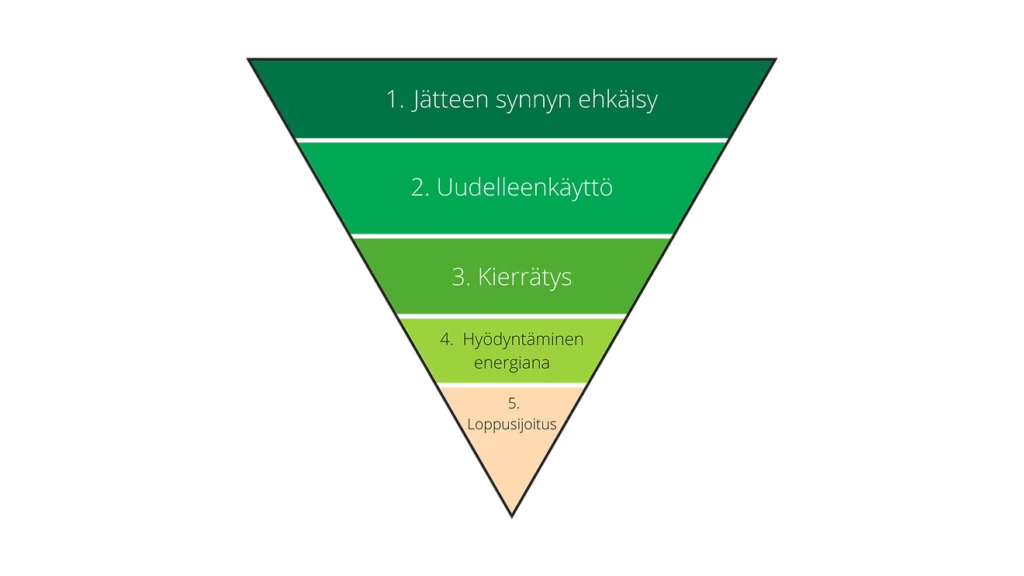
In all our sorting we follow the order of priority required by the Waste Act. In our operations we focus mostly on point 2 of the order of priority, that is, reuse and preparation for reuse. If reuse is not possible, we move on to point 3, recycling, or point 4, recovery as energy.

So we aim primarily to use goods donated to the association in their original purpose – for example a table as a table and a shirt as a shirt. If this is not possible, we consider how it would be most sensible to recycle the goods onward as materials. Only as a last option does the material end up as an energy fraction at the Tammervoima waste-to-energy plant. In that case, district heating and electricity are produced from the waste. We do not transport anything to landfill.

Most of the furniture at the reuse centers, both on the store side and in the staff areas from offices to break rooms, is reused. Computers and other office supplies are also mainly acquired as donations.

The electricity the association buys comes from Tampereen sähkölaitos and is 100 % renewable wind power. All our reuse centers are heated with district heating.

The association has four vehicles, which are used to pick up goods and furniture donated by customers for reuse. One vehicle accumulates about 250 driving days per year and about 600 customer visits per year.

Customer runs are planned so that the routes are direct and sensible, and thereby the runs are also as ecological as possible. Where possible, we also combine different customer visits in order to avoid unnecessary back-and-forth driving.

Circular economy blog